Architectural Fenestration in Hungary: Regulatory Framework & Market Drivers
Hungary’s building sector has undergone a structural transformation driven by strict energy performance mandates. Following the implementation of Hungary's updated 7/2006 (V. 24.) TNM decree regarding the thermal requirements of buildings, and the broader European Energy Performance of Buildings Directive (EPBD), all new construction projects across Budapest, Debrecen, Szeged, and the Lake Balaton resort region must fulfill Nearly Zero Energy Building (NZEB / Közel Noll Energiaigényű) standards.
For architectural specifiers, general contractors, and B2B window profile importers in Hungary, achieving these standards hinges directly on the fenestration profile selection. The window profile system must not only support heavy triple-glazed insulated glass units (IGUs) but must also eliminate thermal bridging across profile joints, frame-to-wall interfaces, and sliding track thresholds.
Technical Insight for Hungarian Specifiers: The Hungarian climate is characterized by a high seasonal temperature differential—ranging from freezing sub-zero continental winters (down to -15°C) to intense summer radiation in the Pannonian Basin (exceeding +35°C). Fenestration profiles imported into Hungary require high structural rigidity, minimal thermal expansion coefficients, and polyamide thermal break widths of at least 24mm to 34mm to prevent structural warping and draft infiltration.
Micro-Climate Considerations Across Hungarian Regions
Fenestration requirements in Hungary differ significantly by project location and architectural typology:
Budapest Urban Retrofits
High historical density in Districts V, VI, and VII mandates strict acoustic isolation (Rw ≥ 42 dB) to attenuate city noise, paired with narrow visual profile sightlines that respect historic elevation aesthetics.
Lake Balaton Coastal Villas
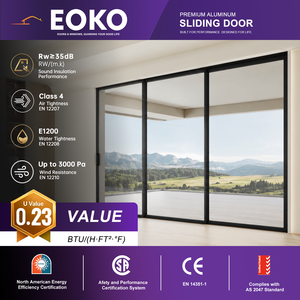
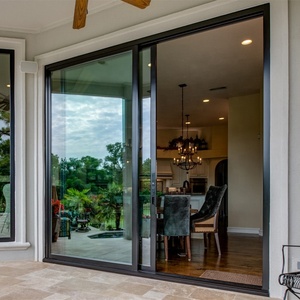
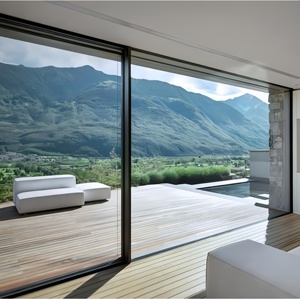
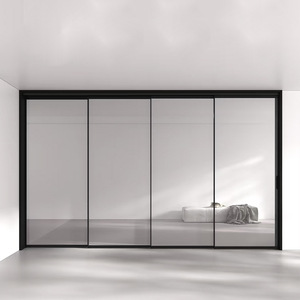
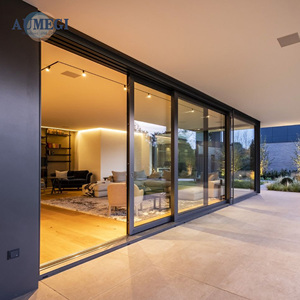
Luxury residential projects along Lake Balaton demand expansive glass sliding doors. Profiles must withstand localized wind pressure spikes while providing high solar heat gain control (g-value optimization).
Industrial Parks & Logistics Hubs
Rapid commercial growth around Győr, Kecskemét, and Debrecen requires cost-effective, high-durability aluminum curtain wall stick systems and heavy-traffic commercial entrance doors engineered for high duty-cycles.
Engineering Deep Dive: Thermal Transmittance (Uw) Calculations
To qualify for Hungarian energy grants and municipal building permits, importers must ensure accurate verification of total window thermal transmittance ($U_w$). The overall window thermal performance is calculated using the EN ISO 10077-1 standard formula:
Uw = ( Ag · Ug + Af · Uf + lg · Ψg ) / ( Ag + Af )
Where:
- Uw: Overall thermal transmittance of the window system (W/m²K).
- Ug: Thermal transmittance of the glazing unit (typically 0.5 to 0.7 W/m²K for gas-filled triple pane glass).
- Uf: Thermal transmittance of the window frame profile (W/m²K), determined by extrusion geometry and thermal breaks.
- Ψg: Linear thermal transmittance coefficient of the warm-edge glass spacer bar (W/mK).
- Ag & Af: Areas of glass and frame respectively.
Our exported aluminum thermal break profiles utilize imported PA66 GF25 (25% glass fiber reinforced polyamide) thermal barriers. This engineered separation prevents heat conduction from inside to outside during harsh winter months, allowing Hungarian fabricators to achieve $U_f$ values down to 1.1 W/m²K and total system $U_w$ values under 0.85 W/m²K.
Fenestration System Comparison Matrix for Importers
Below is a comparative breakdown of our primary window profile categories engineered for export into the Hungarian B2B market:
| Profile System Category |
Frame Depth (mm) |
Thermal Insulation (Uf W/m²K) |
Water Tightness (EN 1027) |
Wind Resistance (EN 12211) |
Primary Application in Hungary |
| Thermal Break Aluminum (Series 75) |
75 mm |
1.2 – 1.5 W/m²K |
Class E1050 (1050 Pa) |
Class C5 (2000 Pa) |
Premium Single-Family Homes & Luxury Apartments |
| Passive House Aluminum (Series 90) |
90 mm |
0.85 – 1.0 W/m²K |
Class E1200 (1200 Pa) |
Class C5 (2000 Pa) |
Low-Energy Buildings & Passive Houses (NZEB) |
| Multi-Chamber uPVC Vinyl (7-Chamber) |
82 mm |
0.95 – 1.1 W/m²K |
Class 9A (600 Pa) |
Class C4 (1600 Pa) |
Mass Residential Developments & Suburban Housing |
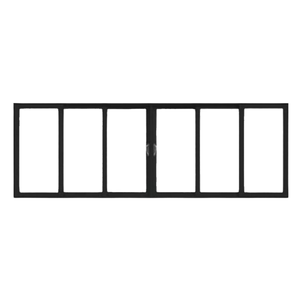
| Minimalist Slim Sliding System |
145 mm (Track) |
1.3 – 1.7 W/m²K |
Class 7A (300 Pa) |
Class C3 (1200 Pa) |
Panoramic Lake Balaton Villas & Penthouse Terraces |
| Unitized Glass Curtain Wall |
160 mm |
1.1 – 1.4 W/m²K |
Class RE1200 (1200 Pa) |
2.5 kPa Design Load |
Commercial Towers & Public Infrastructure (Budapest/Debrecen) |

.webp)