
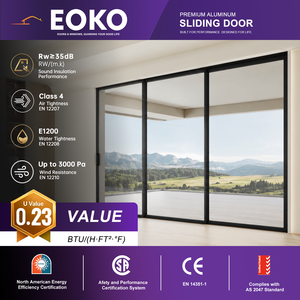
EOKO NFRC Thermal Break Triple-Glazed Lift-and-Slide Aluminum Door
Uw ≤ 0.85 W/m²K
Low-E Triple Glass
Luxury Villa
Direct factory-engineered fenestration solutions tested under EN standards for extreme weather tightness, structural stability, and superior thermal insulation values.
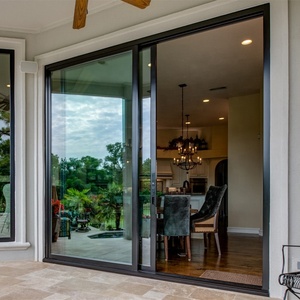
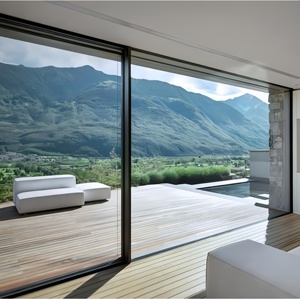
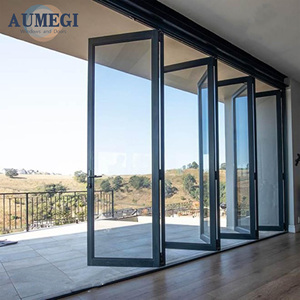
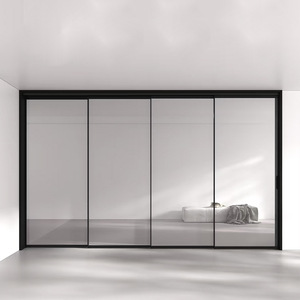
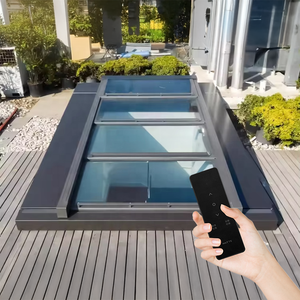
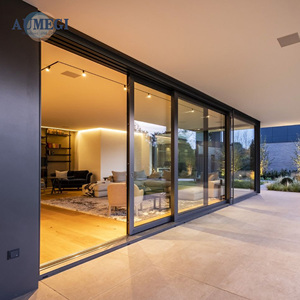
Sourcing luxury folding and sliding door systems for the Norwegian market requires far more than aesthetic evaluation. Norway presents one of the most demanding climatic environments in Europe, characterized by prolonged freezing sub-zero temperatures, intense freeze-thaw cycles, coastal hurricane gales across the North Sea, and stringent national building codes mandated under TEK17 (Byggteknisk forskrift). For developers, architects, and general contractors in Oslo, Bergen, Trondheim, and Tromsø, selecting the right factory partner is critical to avoiding structural seal failures, severe condensation, thermal bridging, and non-compliance fines.
Under Norway’s TEK17 regulations, the overall thermal transmittance coefficient ($U_w$) for windows and exterior glazed doors in residential and commercial envelope assemblies must strictly adhere to localized benchmarks. While standard European sliding doors typically target $U_w$ values between $1.4$ and $1.8 \text{ W/m}^2\text{K}$, Norwegian climate zones demand thermal performance down to $U_w \le 0.8 \text{ to } 1.0 \text{ W/m}^2\text{K}$ for high-efficiency builds and Passive House (Passivhus) installations.
To achieve these aggressive metrics without compromising structural integrity, leading Turkish manufacturing clusters utilize multi-chamber aluminum extrusions integrated with PA66GF25 (25% glass fiber reinforced polyamide) thermal break strips ranging from 24mm to 34mm in width. In combination with argon-filled triple-pane glass units featuring warm-edge composite spacers (TGI/Swisspacer) and double Low-E soft coatings, these systems effectively eliminate cold-bridge paths, preventing indoor frame frosting even when external temperatures plummet to $-25^\circ\text{C}$.
Norwegian coastal geographies (such as Vestland and Nordland) regularly endure severe wind loads up to class C4/C5 under EN 12211 (pressures exceeding 2000 Pa). Standard folding doors often represent the structural weak link in building envelopes due to multiple vertical panel joints and bottom track drain channels.
To combat water ingress caused by wind-driven heavy rains (EN 1027 test pressure up to 750 Pa / E750 rating), our factory designs feature multi-point locking rods operated via heavy-duty gearboxes (such as German ROTO hardware or STAC systems), coupled with continuous co-extruded EPDM gaskets. Furthermore, drainage tracks incorporate concealed check-valves and weep-hole baffles that allow high-volume water evacuation without permitting back-draft airflow during coastal storms.
| Technical Parameter | Standard Export Bifold Door | ALUCCO TEK17-Optimized Folding System | Norwegian Code Requirement (TEK17) |
|---|---|---|---|
| Thermal Transmittance ($U_w$) | 1.6 – 2.2 W/m²K | 0.80 – 1.1 W/m²K | ≤ 1.2 W/m²K (Target ≤ 0.80 for Passivhus) |
| Air Permeability (EN 1026) | Class 2 or 3 | Class 4 (600 Pa) | Class 4 (Airtightness n50 ≤ 0.6 h⁻¹) |
| Watertightness (EN 1027) | Class 5A (200 Pa) | Class E750 / E900 (750–900 Pa) | Class 9A / E750 depending on exposure |
| Wind Resistance (EN 12211) | Class B2 (800 Pa) | Class C4 / C5 (1600–2000+ Pa) | Must match local NS-EN 1991 wind zones |
| Corrosion Resistance | Standard Powder Coating | Qualicoat Class 2 / Qualanod C5 Marine | Required for coastal regions (<5 km from sea) |
Norway's iconic cabin culture (Hytte) demands uninterrupted views of fjords and mountains. In coastal zones like Lofoten or Geiranger, our heavy-duty lift-and-slide glass walls allow massive 3-meter tall panels to glide effortlessly while offering marine-grade resistance against salt fog and gales.
High-density residential projects in Greater Oslo prioritize acoustic comfort ($R_w \ge 42 \text{ dB}$) alongside minimal frame sightlines. Ultra-slim polymer and aluminum sliding partitions merge indoor living rooms with outdoor balconies during summer Midnight Sun months without heat loss in winter.
For hotels and dining venues in Bergen or Trondheim, zero-threshold bi-folding systems provide barrier-free passage compliant with universal accessibility norms. Double-sealed flush tracks maintain warm interiors while opening wide during mild Scandinavian summer days.
Through empirical search intent analysis of Norwegian contractors, private developers, and hardware importers, three dominant market shifts have emerged:
Every door assembly is delivered with complete technical dossiers, including EN 1026 (air tightness), EN 1027 (watertightness), and EN 12211 (wind load) lab certificates required by Norwegian municipal building authorities (Kommuner).
Operating from Turkey’s premier aluminum manufacturing ecosystem, we combine European-grade raw materials (6063-T6 alloy, ROTO / STAC hardware) with optimized production overheads, saving clients 25-40% compared to Scandinavian retail costs.
Glazed units and pre-crimped aluminum profiles are individually corner-protected, moisture-sealed, and loaded into heavy-duty fumigated wooden crates labeled per project elevation for direct delivery to Oslo, Bergen, or Brevik ports.
Yes. Our thermal break folding and lift-and-slide aluminum doors can be specified with multi-chamber profiles and argon-filled triple Low-E glazing units that achieve $U_w$ values down to $0.8 \text{ W/m}^2\text{K}$. Official EN 1026/1027 test declarations are provided for municipal building approval.
For coastal applications exposed to high winds and salt fog, we recommend German-engineered ROTO hardware or heavy-duty STAC multipoint locking gear, combined with 316 stainless steel roller tracks and Qualicoat Class 2 / Qualanod C5 anodized profile surface treatments.
Standard manufacturing cycle for project-based orders takes approximately 3 to 4 weeks following shop drawing sign-off. Direct ocean freight from Turkey to main Norwegian ports (Oslo, Bergen, Stavanger, Brevik) typically requires 12 to 16 transit days.
All export orders are supplied with complete commercial invoices matching official HS codes, detailed packing lists, CE declarations of performance, and certificates of origin (EUR.1 upon request) to ensure smooth customs processing by your Norwegian freight forwarder.
Our engineering team can work directly from architectural elevations, window schedules, or structural CAD files in DWG, DXF, or PDF format. We evaluate wind loads and glass thickness requirements to provide a full thermal calculation within 72 hours.
Absolutely. We specialize in project-consolidated shipments. You can combine folding doors, minimal sliding glass walls, thermal break windows, and bioclimatic pergolas into a single 20ft or 40ft HQ container to optimize freight costs.
Send your architectural elevation drawings or window schedule today. Our technical team will return a complete profile section analysis, TEK17 U-value calculation, and project quotation within 72 hours.