Architectural Insulated Glass Manufacturing for Riyadh’s Built Environment
The urban transformation of Riyadh—driven by Saudi Arabia’s Vision 2030 initiatives, massive municipal infrastructure investments, and flagship master-planned developments such as the King Abdullah Financial District (KAFD), Diriyah Gate, and ROSHN housing projects—has fundamentally shifted building envelope specifications. Central Saudi Arabia presents one of the world's most aggressive meteorological challenges for structural fenestration. With summer ambient shades exceeding 48°C, sol-air surface temperatures on building facades reaching over 75°C, sharp diurnal temperature swings of up to 25°C, and intense ultraviolet radiation levels, standard commercial glazing fails prematurely.
As a leading international manufacturer and technical partner delivering aluminum windows, minimal sliding doors, and structural curtain wall systems from Turkey, ALUCCO engineers specialized Double Glazed Units (DGU) and Triple Glazed Units (TGU) engineered specifically for Riyadh’s extreme desert climate. Achieving low U-values alone is insufficient; insulated glass units deployed in the Najd region must maintain precise Solar Heat Gain Coefficients (SHGC), withstand severe thermal-stress fracture risks, suppress high-decibel desert highway noise, and stop microscopic dust penetration under severe sandstorm conditions (Haboobs).
Technical Information Gain: Standard insulated glass manufactured for temperate European or Asian regions often experiences catastrophic edge-seal failure, desiccant saturation, and thermal stress fractures when exposed to Riyadh’s direct solar irradiance. ALUCCO integrates dual-seal structural silicone secondary sealant matrices with 25% glass-fiber reinforced Polyamide (PA66GF25) thermal breaks to ensure structural integrity across 30+ year lifecycle expectancies.
Physics of Insulated Glass Performance in Central Saudi Arabia
Insulated Glass Units (IGUs) serve as the thermal barrier between air-conditioned indoor spaces (maintained at 21°C–24°C) and the external desert atmosphere. Understanding thermal transfer dynamics requires examining three distinct physics vectors: Radiation, Conduction, and Convective heat flux.
1. Solar Radiation Mitigation & Spectrally Selective Low-E Coatings
Solar heat gain represents over 70% of the total thermal load imposed on air conditioning systems in Riyadh. Solar radiation spans Ultraviolet (UV), Visible Light, and Near-Infrared (NIR) bandwidths. NIR radiation (780nm to 2500nm) generates pure thermal energy upon striking interior surfaces.
To combat this, ALUCCO fabricates IGUs using off-line magnetron sputter vacuum deposition (MSVD) triple-silver Low-Emissivity (Low-E) glass panels on position #2 (inner face of the exterior pane). Triple-silver Low-E coatings selectively reflect up to 92% of NIR thermal wavelengths while allowing high Visible Light Transmittance (VLT > 60%). This achieves a remarkably low Solar Heat Gain Coefficient (SHGC) of 0.20 to 0.23, satisfying both SBC 601 (Saudi Building Code for Energy Conservation) and Mostadam green building ratings without creating dark, overly reflective interior spaces.
2. Convective & Conductive Heat Flux Control (U-Value Optimization)
Conduction occurs through the physical glass mass, aluminum framing, and gas cavities. The overall thermal transmittance of a fenestration assembly, expressed as the $U_w$-value ($W/m^2K$), dictates how much non-solar heat conducts through the facade per degree of temperature differential ($\Delta T$). In Riyadh’s mid-summer peak, $\Delta T$ frequently exceeds 30°C.
Our engineered triple-glazed units utilize 12mm to 16mm warm-edge cavity spaces filled with 90%+ concentration inert Argon gas. Argon exhibits significantly lower thermal conductivity ($0.016 W/m\cdot K$) than standard atmospheric air ($0.026 W/m\cdot K$). When paired with 24mm to 34mm multi-cavity Polyamide thermal break profiles, the overall fenestration thermal transmittance drops from a standard single-pane baseline of $5.8 W/m^2K$ down to $Uw 0.9 - 1.3 W/m^2K$.
Structural Dual-Sealing
Polyisobutylene (PIB) primary seal combined with structural silicone secondary seals to prevent argon gas escape and moisture ingress under high UV load.
SASO & SBC Compliant
Fully compliant with Saudi Standards, Metrology and Quality Organization (SASO 2870/2018) energy labeling and SBC 601 structural wind load requirements.
Desert Acoustic Shielding
Asymmetric laminated glass configurations (e.g., 6mm + 1.52mm PVB + 6mm Outer / 16Ar / 6mm Inner) providing sound reduction up to Rw 44 dB.
Comparative Engineering Performance Matrix
To assist architects, façade consultants, and structural engineers in specifying fenestration packages for Riyadh commercial and residential projects, the following empirical performance dataset contrasts standard market offerings against ALUCCO’s Saudi-optimized insulated glass assemblies:
| Glazing System Configuration |
Overall Thickness |
Center-Glass U-Value ($U_g$) |
System U-Value ($U_w$) |
SHGC / g-Value |
Acoustic ($R_w$) |
| Standard Single Monolithic Clear (Baseline) |
6 mm |
5.7 W/m²K |
5.9 W/m²K |
0.82 |
29 dB |
| Standard DGU Clear + Air Cavity |
24 mm (6+12A+6) |
2.7 W/m²K |
3.1 W/m²K |
0.70 |
32 dB |
| ALUCCO High-Performance DGU Low-E |
28 mm (6+16Ar+6) |
1.3 W/m²K |
1.6 W/m²K |
0.24 |
38 dB |
| ALUCCO Triple-Glazed Low-E (Villa Spec) |
44 mm (6+14Ar+4+14Ar+6) |
0.7 W/m²K |
1.0 W/m²K |
0.21 |
42 dB |
| ALUCCO Acoustic-Laminated TGU (Highway Spec) |
52 mm (8.76Lam+14Ar+6+14Ar+6) |
0.6 W/m²K |
0.9 W/m²K |
0.20 |
46 dB |
Localized Application Scenarios in Riyadh Master-Planned Districts
Different sub-districts and architectural typologies across Riyadh demand highly customized insulated glass and aluminum frame integration:
1. Premium Residential Villas (Al Malqa, Al Nakheel, Hittin & Diplomatic Quarter)
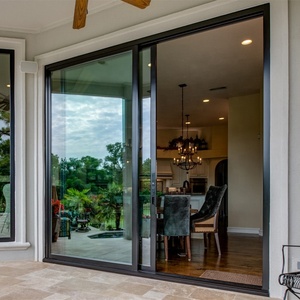
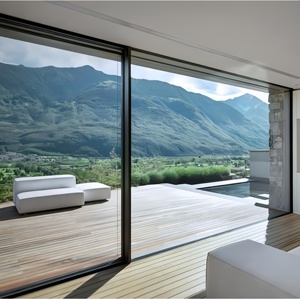
Modern luxury residential architecture in northern and western Riyadh heavily emphasizes seamless indoor-outdoor living, wide span floor-to-ceiling glass elevations, and minimalist structural frames. However, large unshaded glass facades facing South or West absorb vast quantities of radiant heat.
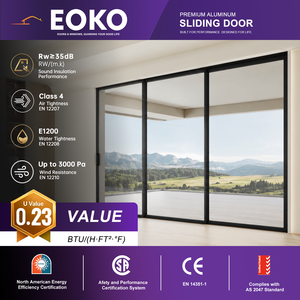
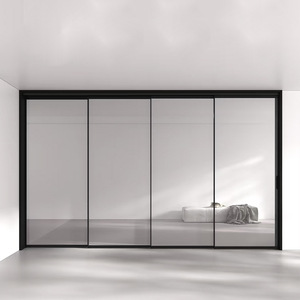
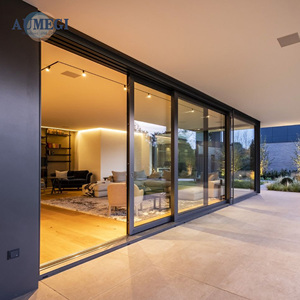
ALUCCO specifies EOKO NFRC Triple-Glazed Lift-and-Slide Systems and Minimalist Slim-Frame Sliding Glass Doors. Featuring structural polyamide thermal isolators and heavy-duty stainless steel tracks, these systems support massive glass panes up to 400 kg per panel. They provide panoramic vistas of private courtyards while preventing heat infiltration, allowing villa owners to maintain cool interior environments efficiently.
2. High-Rise Commercial Towers & Mixed-Use Envelopes (Olaya & KAFD Corridor)
Commercial building envelopes face intense wind pressure loads (up to 2.5 kPa to 3.0 kPa at elevated structural heights) alongside extreme surface heating. Structural silicone glazing (SSG) curtain wall systems must accommodate differential thermal expansion between aluminum mullions and glass panels without seal rupture.
ALUCCO manufactures unitized glass curtain wall panels fabricated with high-modulus, two-part structural silicone sealants (e.g., Dow Corning 983 or IGK equivalents) that pass rigorous EN 12211 wind load resistance testing and EN 1027 rain tightness evaluations. The outer glass pane uses heat-strengthened solar control glass, while the inner pane utilizes fully tempered Low-E glass to eliminate thermal stress breakage risks caused by partial shading from deep exterior louvers.
3. Educational & Healthcare Infrastructure (Vision 2030 Public Megaprojects)
Institutions operating under Saudi Ministry of Education or Ministry of Health guidelines require non-negotiable acoustic insulation to protect learning environments and patient recovery zones from urban traffic noise along major arteries like King Fahd Road and Northern Ring Road. Laminated insulated glass units containing acoustic Polyvinyl Butyral (PVB) interlayers effectively dampen low-frequency transport vibrations.
Saudi Arabia Localized Trends & Standard Compliance (SBC 601 / Mostadam)
The regulatory landscape for building envelopes in Saudi Arabia is undergoing rapid modernization. Developers can no longer rely on obsolete single-pane or basic clear double-pane glass specs. Key trends reshaping procurement include:
- Enforcement of SBC 601 Energy Conservation Code: Mandating maximum allowable $U$-factor and $SHGC$ limits across all residential and commercial building permits issued in the Kingdom.
- Mostadam Sustainability Certification: Saudi Arabia’s localized green building rating system rewards high-performance building envelopes that reduce municipal grid power consumption, encouraging triple-glazed Low-E fenestration usage.
- Thermal Break Aluminum Mandates: Traditional non-insulated aluminum frames suffer from high thermal bridging, acting as heat conductors that radiate warmth directly into living spaces. Thermally broken aluminum extrusions with minimum 24mm polyamide strips are rapidly becoming mandatory across government and private sector projects.
- Dust-Proof Perimeter Engineering: Fine desert silica dust causes rapid degradation of hardware rollers and brush gaskets. ALUCCO integrates multi-point continuous EPDM compression gaskets and concealed drainage valves to prevent dust buildup and water leakage during winter flash rainstorms.
Why Riyadh Procurement Managers & Consultants Partner with ALUCCO
Procuring custom architectural fenestration and structural insulated glass across international borders requires complete supply chain reliability, manufacturing transparency, and strict adherence to project timelines. ALUCCO operates as a specialized engineering and export partner based in Turkey—the region's primary extrusion and glass processing hub—delivering factory-direct solutions engineered directly from client drawings.
Key Enterprise Advantages:
- Precision Turkish Engineering & Extrusion: Fabricated using top-tier CE-marked profiles manufactured to EN 12020-2 tolerances, finished with minimum 60µm Qualicoat-certified architectural powder coatings or anodized finishes built to withstand salt-spray and high UV exposure.
- System Neutrality & Brand Integration: We work seamlessly with premium global hardware systems including ROTO (Germany), STAC (Spain), and master extruders to deliver specified performance specs without tying clients to rigid stock catalog constraints.
- Direct Crated Export Logistics: Every order destined for Riyadh, Jeddah, or Dammam is packed in fumigated (ISPM-15 compliant) solid wooden A-frame crates. Units are corner-protected, vacuum-wrapped, and labeled by building elevation codes to streamline site-level unloading and floor-by-floor installation.
- Turnkey Engineering Dossier: Before production commences, ALUCCO provides complete shop drawings, glass stress calculations, finite element thermal modeling ($U_w$ calculations), and official EN test reports for air permeability (EN 1026), water tightness (EN 1027), and wind load resistance (EN 12211).