
1. Regulatory Compliance: KENAK Energy Efficiency & NZEB Mandates
Building in Greece requires strict adherence to the KENAK (Regulation on the Energy Performance of Buildings), which aligns with European Union Directives for Nearly Zero Energy Buildings (NZEB). The Greek territory is divided into four distinct climate zones (Zone A in the Southern Crete and Dodecanese to Zone D in northern inland mountainous regions like Western Macedonia). Custom OEM fenestration systems must be engineered with calculated thermal transmittance ($U_w$) values tailored to each zone's specific maximum thresholds.
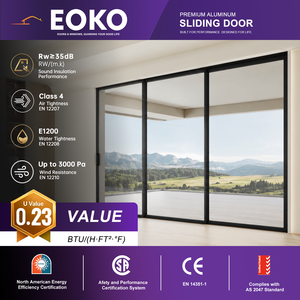
To meet KENAK Tier-A+ building classifications, thermal break window and sliding door systems utilize wide glass-fiber reinforced polyamide strips (PA66 GF25) ranging from 24mm to 38mm. When combined with argon-filled triple-glazed Low-E units and warm-edge composite spacers, our aluminum profiles achieve certified overall assembly values of $U_w \le 0.9 \text{ to } 1.3 \text{ W/m}^2\text{K}$. This minimizes winter thermal bridging while controlling the Solar Heat Gain Coefficient ($g$-value / SHGC) during Greece's intense summer radiation period.
2. Marine Corrosion Resistance: Qualicoat Seaside & Anodizing Protocols
Greece features over 13,676 kilometers of coastline, exposing architectural fenestration to harsh, salt-laden sea air, high humidity, and continuous UV bombardment. Standard architectural aluminum finishes often suffer from filiform corrosion and premature surface oxidation when installed within 5 kilometers of the shoreline (such as in Cycladic island builds or Attica coastal developments).
Our manufacturing facility implements strict pre-treatment and surface finishing protocols certified to Qualicoat Class 2 / Qualicoat Seaside and Qualanod (minimum 25-micron layer thickness). We utilize primary extrusion billet alloy 6063-T6 with controlled copper and iron impurity levels (<0.1%), preventing micro-galvanic corrosion cell formation. Stainless steel fasteners (Grade 316 / A4), marine-grade EPDM rubber gaskets, and isolated hardware tracks ensure complete structural longevity under C4-M and C5-M atmospheric corrosivity categories.
3. Wind Load Hydrodynamics & Meltemi Gale Engineering
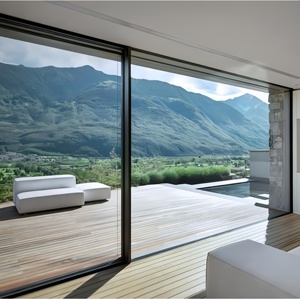
The Aegean region experiences the seasonal Meltemi winds—strong, dry northerly gales reaching Beaufort Force 8 to 10 (wind speeds exceeding 100 km/h) with gust pressures topping 2.4 kPa. For oceanfront villas in Mykonos, Santorini, or Paros featuring expansive floor-to-ceiling glass walls, window structural deflection must be rigorously limited to $L/300$ or $L/200$ according to EN 12211 standards.
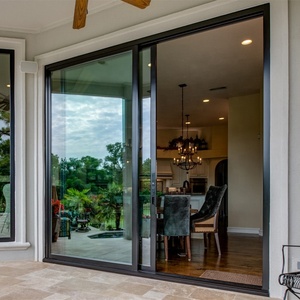
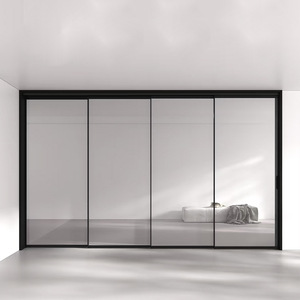
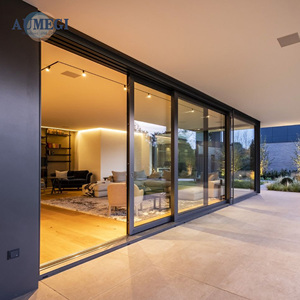
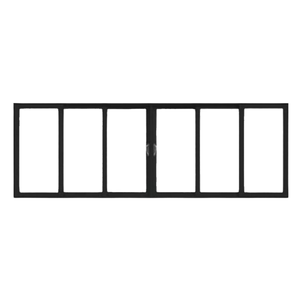
Our OEM custom aluminum sliding door profiles integrate internal structural steel tube reinforcements and thick-walled aluminum mullions with moment of inertia ($I_x$) values optimized for large spans. Heavy-duty tandem stainless steel rollers engineered to support individual sash weights up to 400 kg ensure frictionless operation even under severe positive and negative wind load suction.
4. Seismic Resilience & Structural Deflection Joints
Located along major tectonic plate boundaries, Greece is the most seismically active country in Europe. Architectural window frames and curtain wall facades must accommodate lateral storey drift during seismic events without compromising structural integrity or shattering glass panes.
Our systems incorporate dynamic expansion joints, structural silicone perimeter anchors, and flexible EPDM isolators tested in accordance with EN 14351-1. This allows controlled frame movement during seismic oscillations while maintaining continuous air permeability (EN 1026 Class 4) and watertightness (EN 1027 Class E1050) performance post-event.