Precision-manufactured thermal break aluminum and vinyl glazing solutions custom-fabricated for high-load architectural envelopes.
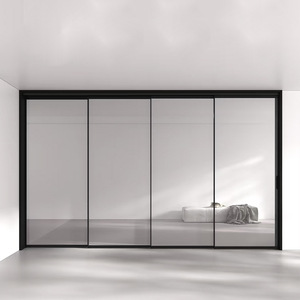
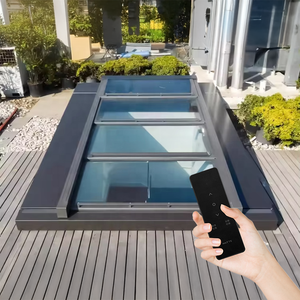
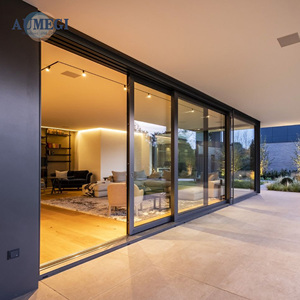
An authoritative technical analysis of thermal transmittance physics, structural glazing engineering, automated insulating glass unit (IGU) manufacturing, and strategic procurement frameworks for B2B importers.
In modern architectural envelope engineering, the transition from double glazing to Custom OEM Triple Glazing represents a fundamental leap in thermodynamic management. Standard double-glazed insulated glass units (IGUs) typically achieve overall window U-values (Uw) between 1.4 W/m²K and 2.2 W/m²K. In contrast, advanced triple glazed configurations engineered by specialized OEM manufacturers regularly deliver centre-of-glass thermal transmittance ($Ug$) ratings as low as 0.5 W/m²K to 0.7 W/m²K, resulting in complete system performance ($Uw$) reaching under 0.8 W/m²K, fully compatible with Passive House (Passivhaus) Standard requirements.
This exceptional thermal resistance is governed by the strategic arrangement of three distinct glass panes enclosing two hermetically sealed gas cavities. To optimize energy performance without compromising visible light transmittance ($Tv$), OEM factories engineer precise photometric coatings across the glass surfaces (numbered 1 to 6 from exterior to interior):
Multi-layer silver sputtering allows visible wavelengths (380–780 nm) to penetrate while reflecting radiative thermal energy. Customizable light transmission ratios range from 50% to 74% tailored to tropical or arctic climate zones.
Replacing legacy aluminum box spacers with composite stainless-steel plastic or Thermoplastic Spacers (TPS) reduces perimeter linear thermal bridging ($\Psi$-value) from $0.08 \text{ W/m·K}$ down to $0.028 \text{ W/m·K}$, entirely eliminating perimeter condensation risk.
As a specialized custom triple glazing manufacturer and architectural system factory, production precision must strictly adhere to international quality frameworks, including EN 1279 (Parts 1 to 6), ASTM C1036, and NFRC standards. Fabricating triple glazed units introduces heightened structural complexity compared to double glazing, primarily due to increased weight and internal thermal stress handling.
A certified OEM manufacturing workflow incorporates automated robotics across four key engineering phases:
CNC glass cutting tables process jumbo sheets (up to 3300mm x 6000mm) with precision arrissing and perimeter Low-E edge-deletion to ensure flawless silicone adhesion.
Forced-convection tempering furnaces toughen glass sheets to withstand high wind pressures. Heat Soak Testing (HST) to EN 14179 eliminates spontaneous nickel sulfide (NiS) inclusion breaks.
Robotic assembly lines apply warm-edge spacers, automatically align three panes, inject 95% Argon gas in a sealed vacuum chamber, and apply primary polyisobutylene (PIB) sealants.
Dual-component structural silicone or polyurethane secondary sealants are robotically extruded to ensure hermetic cavity integrity, gas retention, and structural load resistance for 30+ years.
Furthermore, integrating triple glazed IGUs into aluminum frame systems demands heavy-duty extruded aluminum profiles, typically using 6063-T6 or 6005-T6 architectural alloys. Multi-chamber thermal break profiles equipped with Polyamide 66 reinforced with 25% glass fiber (PA66-GF25) thermal barrier strips (widths ranging from 24mm to 54mm) ensure that the aluminum frame match the ultra-low U-values achieved by the triple glass assembly.
To assist architects, structural engineers, and global procurement managers in selecting the ideal glazing specification, the following data matrix provides a comprehensive performance benchmark across primary glazing configurations:
| Glazing Specification | Overall Thickness | Centre Glass Ug (W/m²K) | Solar Factor (g-value) | Sound Insulation (Rw) | Structural Weight (kg/m²) |
|---|---|---|---|---|---|
| Standard Double Glazed (Low-E) 6mm Low-E + 16Ar + 6mm Clear |
28 mm | 1.1 – 1.4 | 0.62 | 31 – 35 dB | 30 kg/m² |
| High-Insulation Triple Glazed (Standard) 4mm Low-E + 12Ar + 4mm Clear + 12Ar + 4mm Low-E |
36 mm | 0.7 – 0.8 | 0.52 | 36 – 40 dB | 45 kg/m² |
| Custom OEM Triple Glazed (Acoustic Laminated) 6mm Low-E + 14Ar + 5mm Clear + 14Ar + 8.76mm Soundproof PVB |
43.76 mm | 0.5 – 0.6 | 0.45 | 44 – 48 dB | 58 kg/m² |
| Hybrid Vacuum Triple Glazed (Next-Gen) 4mm Low-E + 0.3V + 4mm Clear + 12Ar + 4mm Low-E |
24.3 mm | 0.4 – 0.5 | 0.48 | 39 – 42 dB | 45 kg/m² |
As international building codes enforce stringent carbon reduction targets (such as the European Union’s Energy Performance of Buildings Directive and North America’s updated IECC codes), commercial procurement of envelope fenestration is undergoing three major structural shifts:
B2B buyers increasingly require Environmental Product Declarations (EPDs). OEM factories are adopting hydro-powered recycled aluminum extrusions (content >75% scrap) to reduce embodied carbon from $18 \text{ kg CO}_2/\text{kg}$ to under $4 \text{ kg CO}_2/\text{kg}$ of profile.
Urban densification demands hybrid IGU designs integrating asymmetric glass thicknesses (e.g., 8mm exterior + 6mm middle + 10.76mm acoustic PVB laminated interior). This disrupts sound wave resonance across high and low frequencies simultaneously.
Architects demand minimal frames (interlocks under 20mm sightline) without sacrificing thermal metrics. This requires high-modulus structural silicone bonding where the triple glazed pane acts as a rigid structural stiffener for the frame.
Operating as a premier export-oriented architectural factory hub (leveraging Turkey's advanced industrial aluminum cluster and European testing compliance), our manufacturing ecosystem eliminates intermediate commercial markups while providing rigorous technical oversight from drawing submittal to jobsite delivery.
Our OEM enterprise capability includes:
Direct answers to crucial structural, thermal, and logistics queries raised by commercial contractors and OEM importers.
For Argon gas infill, thermal physics dictates an optimal cavity width of 12mm to 16mm. Cavities narrower than 10mm increase conductive heat loss, while cavities wider than 18mm trigger internal convective loop currents, reducing overall insulating performance. For Krypton gas, optimal cavity spacing is narrower, ranging between 8mm and 10mm.
The central pane of a triple glazed unit absorbs heat trapped between the inner and outer cavities, leading to higher thermal expansion stress. To prevent thermal shock cracking, our OEM facility recommends heat-strengthening or full toughening (tempering) for the middle glass pane, combined with polished polished edges (arrissing) across all three panes.
We work on a project-consolidated basis rather than strict standard piece counts. For custom extrusion profiles, standard MOQ starts at 500 kg per die section. For completed window and door assemblies, a consolidated 20ft or 40ft container load (combining windows, sliding doors, and hardware for a full project elevation) represents the most cost-effective entry point.
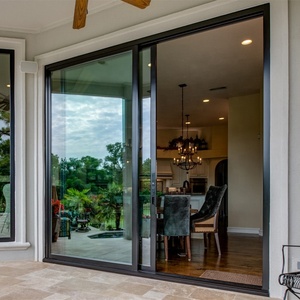
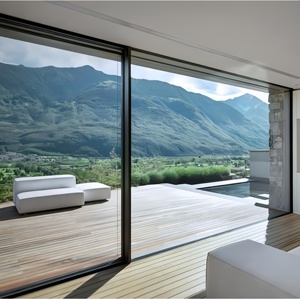
Yes. Utilizing engineered thermal break lift-and-slide systems (such as 160mm to 250mm depth frames) equipped with heavy-duty stainless-steel tandem rollers, single sash weights up to 400 kg can slide effortlessly. Maximum panel dimensions can reach up to 3.0 meters wide by 3.5 meters high per sash, using 8mm toughened triple-pane glass build-ups.
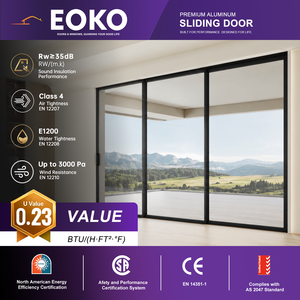
Every project shipment includes a certified Technical Quality Dossier comprising EN 1026 Air Permeability (Class 4), EN 1027 Watertightness (up to Class E1050), EN 12211 Wind Load Resistance (Class C5/C4), EN 1279 IGU Gas Retention & Seal Integrity certificates, and Qualicoat powder coating thickness inspection sheets.
Standard triple glazing with equal glass thickness (e.g., 4mm + 4mm + 4mm) performs modestly in sound reduction due to internal harmonic resonance frequencies. However, when engineered with asymmetric glass thicknesses (e.g., 6mm + 4mm + 8mm) or incorporating PVB acoustic laminated glass, sound transmission loss increases dramatically from 32 dB up to 48 dB (Rw).
Submit your architectural elevations, DWG window schedules, or structural tender specifications. Our engineering office delivers complete thermal calculations, profile cross-sections, and factory-direct commercial estimates within 72 hours.
