
Navigating China's Aluminum Cladding & Systems Manufacturing Sector
An engineering guide for facade consultants, EPC contractors, and commercial developers seeking thermal integrity, structural compliance, and supply chain transparency.
In global commercial architectural design, selecting the right metal facade supplier and fenestration manufacturing partner is a high-stakes engineering decision. China's industrial aluminum ecosystem produces over 55% of the world's architectural extrusions. However, navigating the tier-one landscape of China's best aluminum cladding manufacturers & factories requires a granular understanding of metallurgical standards, surface coating polymer science, structural thermal breaks, and international building code testing certifications.
This whitepaper provides actionable technical insights and intent-driven evaluation criteria designed to bridge the information gap between project specifications and factory floor capabilities in China.
1. Metallurgical Excellence & Composite Material Engineering
A primary criterion for distinguishing elite Chinese aluminum factories from standard extruders lies in raw alloy purity, thermal processing control, and sheet lamination chemistry. Top-tier manufacturers strictly enforce AA 6063-T5 / T6 structural temper profiles for framing and structural sub-mullions, ensuring ultimate tensile strength exceeding 205 MPa.
For horizontal and vertical building envelopes, modern cladding systems primarily utilize three material typologies:
- Aluminum Composite Panels (ACP): Composed of a fluoropolymer-coated aluminum sheet bonded to a non-combustible mineral core. Premier Chinese manufacturers utilize continuous hot-roll lamination with 0.5mm 3003-H24 aluminum skins, paired with FR (Fire Retardant) mineral cores achieving EN 13501-1 Class A2-s1, d0 ratings.
- Solid Aluminum Plate (3003-H14 / 5052-H32): Ranging from 2.5mm to 4.0mm thickness, these solid plates undergo precision CNC turret punching and hydraulic bending before receiving multi-coat PVDF liquid spraying. They offer 100% recyclability and zero risk of delamination under extreme wind pressure.
- Aluminum Honeycomb Panels: Engineered for ultra-flat, high-rise building envelopes. Utilizing hexagonal aluminum cores (cell size 1/4" to 3/8") bonded with structural epoxy adhesives, these panels provide high stiffness-to-weight ratios for oversized facade modules.
Comparative Performance Matrix: Facade Cladding Technologies
| Cladding System | Core Composition | Standard Thickness | Thermal Transmittance (U-Value) | Fire Reaction Class | Max Wind Load (ASTM E330) |
|---|---|---|---|---|---|
| A2 Fire-Rated ACP | 90%+ Inorganic Mineral Core | 4.0mm / 6.0mm | 5.4 W/m²K | Class A2-s1, d0 (EN 13501) | ± 4.5 kPa |
| Solid Fluoropolymer Sheet | Monolithic 3003-H14 Alloy | 3.0mm Structural | 5.8 W/m²K | Class A1 Non-Combustible | ± 6.0 kPa |
| Aluminum Honeycomb | Hexagonal 3003 Core | 15mm - 25mm | 2.1 W/m²K (with cavity fill) | Class A2-s1, d0 | ± 8.0 kPa |
| Thermal Break Profile | PA66GF25 Polyamide Bar | 60mm - 95mm System | 0.9 - 1.8 W/m²K | B-s1, d0 (Profile Assembly) | Class C5 (≥ 2.0 kPa) |
2. Surface Treatment Science: PVDF Coating vs. Anodizing Integrity
Building longevity depends directly on resistance to atmospheric pollutants, solar radiation degradation, and salt-spray corrosion. When auditing Chinese manufacturers, facade engineers must verify compliance with strict international coating specifications:
PVDF (Polyvinylidene Fluoride) Fluoropolymer Systems: Advanced factories deploy automated 3-coat/3-bake or 4-coat PPG/AkzoNobel coating lines certified to AAMA 2605 specifications. A minimum 70% Kynar 500 / Hylar 5000 resin content guarantees that color shift remains under ΔE < 5 units over a 20-year exposure lifecycle in tropical coastal environments.
Anodic Oxidation Finishing: For metallic aesthetic depth, top-tier factories utilize chemical polishing and anodic bath tanks operating under Class 20 (minimum 20 micron coating thickness) standards compliant with Qualanod rules. This provides surface hardness rivaling quartz and immunity to organic solvent deterioration.
3. Thermal Performance & System Integration Engineering
Modern building codes demand low solar heat gain coefficients (SHGC) and minimal thermal bridging. Leading Chinese manufacturers have evolved beyond simple profile suppliers into integrated system engineers.
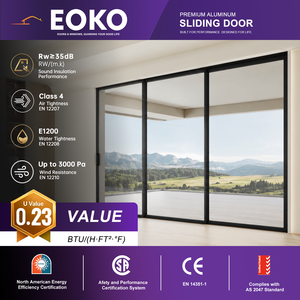
By incorporating 24mm to 34mm PA66-GF25 (25% Glass Fiber Reinforced Polyamide) thermal breaks, engineered profiles decouple external thermal energy from internal ambient environments. When paired with triple-glazed Low-E insulated glass units (IGUs) filled with 90% Argon gas and warm-edge spacers, frame U-values achieve impressive ratings down to Uw ≤ 0.9 W/m²K.