0%

A door handle is touched every day, yet it is often chosen after the door itself. Luxury Aluminum Door Handles can bring a clean, refined look to an entrance without the weight of many solid-metal alternatives. Their quality, however, depends on more than a polished surface. Alloy composition, construction, finish, and hardware all affect how a handle feels and performs over time.

Start by considering the room and the people who will use it. A slim lever may suit a contemporary interior, while a rounded grip can feel more comfortable in a busy family home. Small details matter. Check that the handle matches the door thickness, spindle, and lock setup, and ask the manufacturer for installation specifications before ordering. Finishes also deserve a close look: a brushed surface may disguise fingerprints better than a glossy one, though cleaning needs vary by coating. Requesting a physical sample can reveal color and texture differences that product photos hide.

Durability is not automatic. Ask about the aluminum grade, protective coating, corrosion resistance, and warranty, especially for handles near damp rooms or exterior doors. A dependable supplier should provide clear product information rather than broad promises. Read care instructions, too; abrasive cleaners can damage some finishes. A sample may look perfect under showroom lighting and feel different at home. That is worth remembering. The following guide explains how to compare design, comfort, compatibility, and long-term value so you can choose a handle that suits both the door and everyday use.
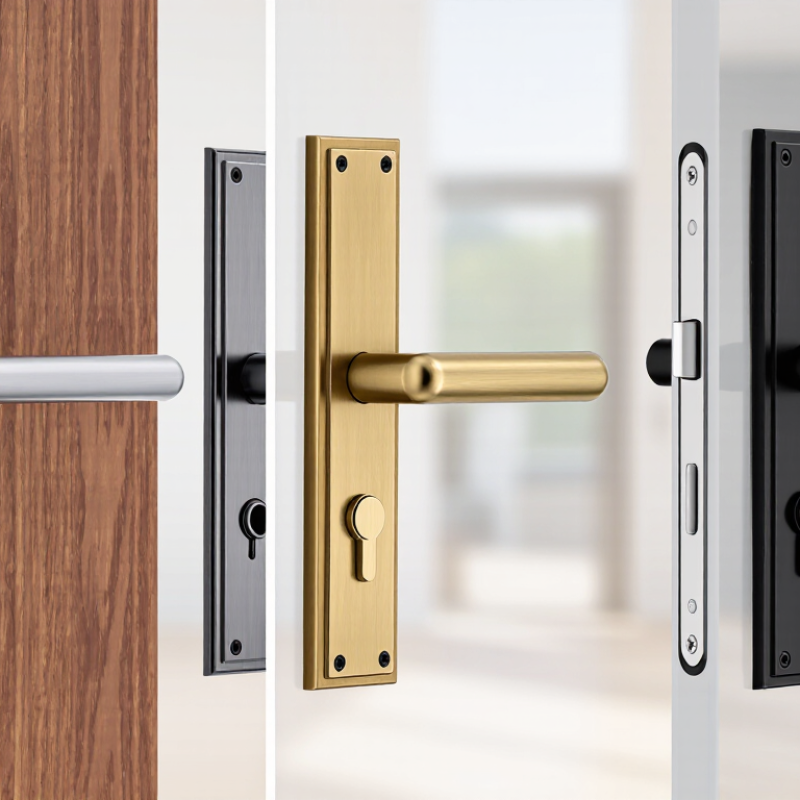
How to Choose Luxury Aluminum Door Handles

Understanding Luxury Aluminum Door Handles and Their Key Features

Luxury aluminum door handles feel refined when their details work together. Aluminum is light, but the handle should not feel flimsy. Check its alloy, wall thickness, and connection to the spindle. A firm grip should feel smooth, with no sharp edges or rattling. Small details matter. A warm satin finish can soften a minimalist door, while a polished surface shows fingerprints more readily. That trade-off is easy to miss in a showroom.

The finish protects the surface as well as shaping its appearance. Ask how it resists abrasion, moisture, and fading, and request relevant test documentation. ANSI/BHMA A156.18 covers materials and finishes for builders’ hardware; ISO 9227 describes salt-spray testing. These references help frame questions, but they do not guarantee identical performance in every home. Check that the rosette sits flat and the fixing screws feel secure. Feel it first. A handle that looks elegant but pinches the fingers is not a good choice.

Material sourcing can matter, too. The International Aluminium Institute reports that recycling aluminium uses about 5% of the energy required for primary production. That is a useful sustainability data point, not proof that any specific handle contains recycled metal. Ask suppliers for product-specific material information. I would also compare the handle’s finish under natural light, not only under warm showroom lamps. It is a small, imperfect check, but it can reveal a color shift before installation.

Choosing aluminum for a door handle: Tensile strength is one useful comparison, but it does not determine overall quality. Consider finish durability, corrosion resistance, ergonomics, hardware compatibility, and the manufacturer’s product specifications as well.

Indicative minimum tensile-strength values for extruded products; actual requirements vary by product dimensions and applicable specifications.

Identifying Door Type, Usage, and Functional Requirements

Choose the handle for the door’s job, not just its finish. A bedroom door used a few times daily has different needs from a busy office entrance. On a solid interior door, a lever can be easier to operate than a small round knob. For a sliding door, check that the grip clears the pocket and feels secure with wet or gloved hands. A polished handle can still be the wrong choice.

For accessible spaces, use recognized technical guidance. The U.S. Access Board’s 2010 ADA Standards place operable parts 15 to 48 inches above the floor and require operation with one hand, without tight grasping, pinching, or wrist twisting. Section 404.2.9 also limits opening force for many interior hinged doors to 5 pounds; this applies to opening the door, not simply turning its handle. Confirm local project requirements, especially for exterior and fire doors. Small details matter.

For high-traffic doors, ask for documented durability testing and check that the latch, spindle, and handle suit the door’s thickness and handing. ANSI/BHMA A156.2 covers bored locks, while A156.13 addresses mortise locks; the relevant standard depends on the hardware type. I would also test the handle in place. A sample can feel balanced on a counter, then awkward beside a narrow frame. That is easy to overlook.

Comparing Aluminum Grades, Finishes, and Design Options

Luxury aluminum door handles should feel solid, not merely look polished. Alloy choice influences weight, machining, and resistance to everyday wear. Many handles use 6063 aluminum for its smooth finish and good corrosion resistance. 6061 is generally stronger, though the difference may matter less than the handle’s shape and mounting. Ask about the alloy and surface treatment, rather than judging by appearance alone. A thin handle with a beautiful finish can still feel flimsy in the hand. Feel matters.

Finish changes both character and care. Brushed anodizing reveals a fine, directional grain and helps protect the surface; fingerprints may show less than on a mirror polish. Powder coating offers more color choices, but chips can be noticeable on sharp edges. Polished aluminum catches light, yet needs more frequent wiping. Compare samples beside the actual door, in daylight and warm indoor light. A small swatch can mislead. I have found that a subtle mismatch looks larger once the handle is installed. Design details count, too: rounded edges feel gentler, while a slim lever suits a restrained interior. Check the grip with a relaxed hand, and confirm that the finish feels even around corners and fixing points.

Checking Handle Dimensions, Mounting, and Lock Compatibility

Before choosing a luxury aluminum door handle, measure the door, not just the old handle. Record the door thickness, handle spindle size, and the distance between fixing screws. For a lock, measure the backset from the door edge to the spindle center, plus the distance between the spindle and keyhole. Small mismatch. Big problem. A few millimeters can leave the spindle short or the screw holes exposed. Aluminum profiles may also be narrow, so check that the supplied fixings suit the door’s construction and reinforcement.

Check mounting and lock compatibility as one system. Confirm whether the door uses a mortise lock or a separate latch, and whether it opens left or right. The U.S. Access Board’s 2010 ADA Standards place operable door hardware 34–48 inches above the finished floor; this is a useful accessibility benchmark, though project requirements vary. The same standards limit operating force to 5 pounds where applicable. That figure concerns operation, not a guarantee that every handle will feel effortless. I still recheck measurements on site: drawings can miss trim, seals, or a replaced lock case. Choose a handle whose spindle, fixing pattern, and lock mechanism match the actual door, then test the latch and key before final tightening.

How to Choose Luxury Aluminum Door Handles - Checking Handle Dimensions, Mounting, and Lock Compatibility

Check What to Measure Common Values or Guidance Compatibility Tip
Door thickness Measure the finished door leaf from face to face, including any applied finish. Many residential doors are approximately 35–45 mm thick, but aluminum door systems vary. Confirm the handle set’s stated door-thickness range and whether longer fixing bolts or a longer spindle are required.
Handle projection and length Check the lever length and how far it projects from the door face. Dimensions differ by design; compare the handle drawing with nearby walls, frames, glazing, and adjacent hardware. Allow enough clearance for a full lever turn without striking a wall, frame, or window fitting.
Spindle size and length Measure the square spindle width and the length needed to pass through the lock follower and both handle hubs. An 8 mm square spindle is common in many European handle and lock systems; other sizes are also used. Match the spindle to the lock follower and handle hubs. Do not assume a spindle from one system fits another.
Handle fixing centres Measure between the centres of the handle’s mounting screws or through-bolts. There is no single universal fixing-centre dimension; it depends on the handle plate and door preparation. Compare the exact fixing pattern with the existing holes and the aluminum profile’s reinforcement or fixing points.
Lock-centre spacing (PZ) For a lever handle with a cylinder cut-out, measure from the spindle centre to the euro-cylinder centre. 72 mm, 85 mm, and 92 mm are common PZ dimensions in some European multipoint lock systems. Use the lock manufacturer’s specified PZ dimension; a handle with a different centre spacing will not align correctly.
Lock backset Measure from the door edge to the centre of the spindle follower, following the lock’s measurement method. Backset varies by lock case and door system; it is not interchangeable with PZ spacing. Check the lock-case drawing and the door preparation before selecting the handle or replacement lock.
Cylinder clearance Check the cylinder type, centre position, and projection from the handle plate or escutcheon. Euro-profile cylinders are commonly used with compatible euro-cylinder lock cases, but their lengths must suit the door and trim. Ensure the key can be inserted and turned without the handle plate obstructing it; avoid excessive cylinder projection.
Mounting method Identify whether the handle uses face screws, concealed screws, or through-bolts passing between the door faces. Aluminum doors may have narrow profiles, internal reinforcement, or system-specific fixing points. Use fixings approved for the door construction. Do not drill into a profile without checking its system layout and reinforcement.
Handing and operation Determine whether the door is left- or right-handed and whether the lever is reversible. Some lever designs are reversible; others have a fixed orientation or are supplied as handed pairs. Confirm the handle’s orientation and the lock’s operation before ordering, especially for asymmetric designs.
Finish and environment Consider exposure to rain, coastal air, cleaning products, and frequent handling. Aluminum handles are available with different finishes and protective coatings; performance depends on the material and finish specification. Choose a finish rated for the door’s exposure and follow the supplier’s cleaning and maintenance instructions.

Measurement note: Dimensions shown as common values are examples, not universal standards. Verify the door, handle, and lock manufacturer’s drawings before drilling or ordering replacement hardware.

Evaluating Quality, Installation, and Long-Term Maintenance

A luxury aluminum door handle should feel precise, not merely heavy. Weight alone proves little. Check that the lever moves smoothly, returns without sticking, and has no sharp casting edges. A consistent finish matters, too: inspect corners and the area around the rose, where thin coatings or uneven color can show first. Ask about the aluminum alloy and finish process, but judge them alongside the handle’s intended setting. A door exposed to damp air or frequent handling needs more attention than a lightly used interior door.

Tips: Measure the door thickness and existing spindle before ordering. Use the supplied template, keep the handle level, and tighten screws gradually. Overtightening can distort parts or make the lever bind.

Installation affects long-term performance. After fitting, test the latch several times with the door open, then closed. If the lever scrapes or feels stiff, check alignment before forcing it. For maintenance, wipe the handle with a soft cloth and mild soapy water, then dry it. Avoid abrasive pads and harsh cleaners, which may dull the finish. Every few months, check visible screws for looseness. Small checks help, though they cannot prevent every finish change; sunlight, moisture, and daily contact may slowly alter the surface. A premium label is not a maintenance plan.

FAQS

How should I choose a door handle for a bedroom or busy office?

Match the handle to how often the door is used. A lever may be easier to operate than a small knob on a solid interior door.

What should I check before choosing a handle for a sliding door?

Make sure the grip clears the pocket and feels secure. Try it with wet or gloved hands if that suits the space.

What accessibility details should I consider?

Recognized guidance commonly places operable parts 15 to 48 inches above the floor. They should work with one hand, without tight grasping, pinching, or wrist twisting.

Does the five-pound opening-force limit apply to turning the handle?

No. The cited guidance applies to opening many interior hinged doors, not simply turning the handle. Check local project requirements, especially for exterior or fire doors.

What should I check for a high-traffic door?

Ask for documented durability testing. Confirm that the latch, spindle, and handle suit the door’s thickness and handing. Test the handle in place; a counter sample can feel different.

How do aluminum grades affect a handle?

Many handles use 6063 aluminum for its smooth finish and corrosion resistance. 6061 is generally stronger, but shape and mounting may matter more in some installations.

Which finish is easiest to live with?

Brushed anodizing has a directional grain and may show fewer fingerprints than mirror polish. Powder coating offers more colors, while chips can stand out on sharp edges.

How can I tell whether a handle feels right?

Hold a sample beside the actual door, in daylight and warm indoor light. Check the grip, corners, and fixing points. I still find small finish mismatches surprisingly noticeable.

Conclusion

Choosing Luxury Aluminum Door Handles involves balancing appearance, durability, comfort, and practical function. Start by considering the door type and how often it will be used, since an interior door, entry door, or frequently handled door may call for different levels of strength and ease of operation. Compare aluminum grades, surface finishes, and design styles to find an option that suits the setting while offering suitable resistance to everyday wear.

Before purchasing, check the handle’s dimensions, mounting arrangement, and compatibility with the door’s lock or latch. These details help ensure a secure fit and smooth operation. Also consider the quality of the components and the installation requirements, following the manufacturer’s instructions or seeking professional help when needed. With routine cleaning and occasional checks of the fittings, a well-chosen handle can remain attractive and functional over time.

Amelia

Amelia

Amelia is a dedicated marketing professional with a deep understanding of the company’s products, customers, and evolving market needs. Through her clear, practical, and insight-driven writing, she regularly contributes expert articles to the company website, helping readers make informed decisions......